
Have Any Questions?
+917901830105
How to Build Website Authority in 2026: Beyond Backlinks — What Google AND AI Search Actually Want
- Home
- Blog
- Uncategorized
- Blog Details
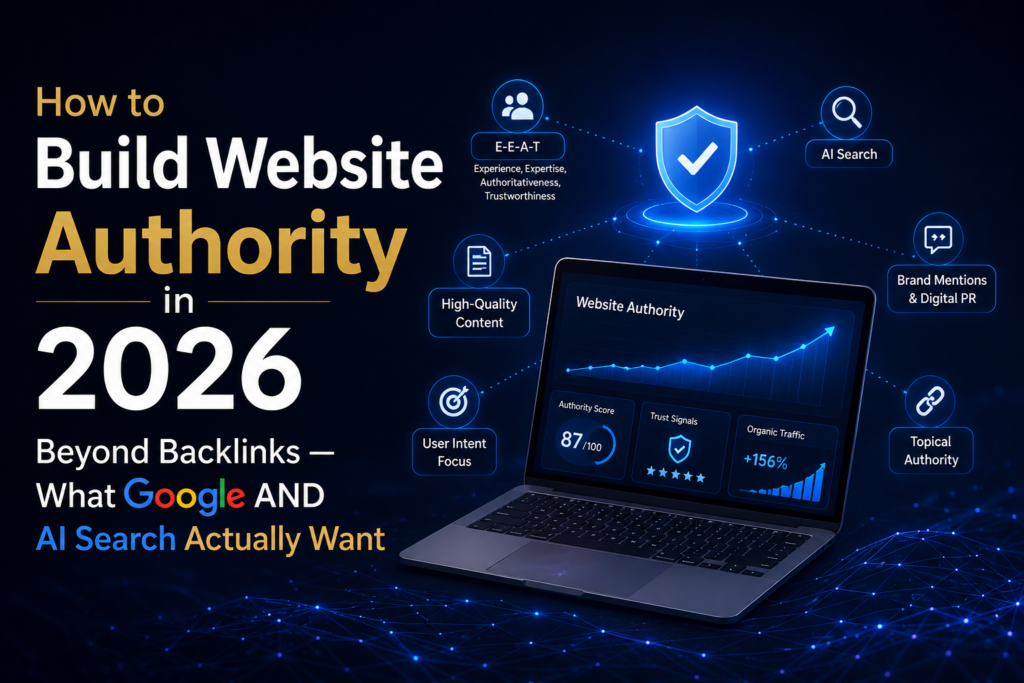
How to Build Website Authority in 2026: Beyond Backlinks — What Google AND AI Search Actually Want
For years, SEO experts believed that backlink building was a quantity game: the more backlinks you could acquire, the better your ranking. It made sense. It worked. Until it didn’t. Search engines, and AI platforms such as ChatGPT, Perplexity, and Google’s AI Overviews, are now fundamentally rethinking their approach to trustworthiness in 2026. No more counting links! They’re asking a more serious question: “Is this brand genuinely recognized as an authority in its field?”
That is your response if you’re just about to say “we have backlinks.” In this guide, you’ll know exactly what authority is in 2026 and how you can create the type Google and AI search engines love.
Why the Old Way of Building Authority No Longer Works
Let’s face the facts about what authority building used to mean:
- Purchase or get as many backlinks as you can.
- Get a guest post on any blog or site that accepts guest posts
- List your site on directories
- Repeat at scale
Google’s algorithms, now enhanced by cutting-edge AI, are far more adept at identifying it. In 2026, you’re not just ignoring low-quality, spammy or irrelevant backlinks. They can actually be detrimental to your rankings.
The bigger shift: AI search changed everything
If you type something into ChatGPT, Perplexity, or Google’s AI Overviews, those don’t simply consider your backlink count. They look at:
- The number of times your brand is referenced (even if not linked) online
- Where you are cited — do these sources seem reliable and relevant?
- What are the news and conversations about your brand?
In addition to your experience, do you know how to apply it to several platforms?
A brand mentioned 50 times on high-authority news sites, podcasts, and industry publications will outperform a brand with 500 generic backlinks every single time.
The 5 Pillars of Authority Building in 2026
Topical Authority — Become THE Expert on Your Subject
Google isn’t satisfied with a single quality article in 2026. It wants to acknowledge you as the best for a whole area of a topic.
Topical authority becomes visible when Google sees: “This brand has a full grasp of this topic (from A to Z).
How to build topical authority:
- Build extensive topic clusters — multiple pages of content with a strong pillar page, covering a wide range of topics.
- Spend some time creating high-quality content for your niche from every perspective: beginners, advanced, case studies, FAQs, comparison articles
- Be consistent — post in your niche and not just any other topic.
All the content in the system is linked internally: your pillar page links to sub-topics, and the sub-topics link back to the pillar page.
Real example: If you create one blog post, “SEO tips”, make a cluster of blogs, including: “What is SEO?” → “Technical SEO Guide” → “Keyword Research Tutorial” → “Link Building Strategies” → “Local SEO for Small Business” Google starts considering you a thorough, trustworthy source — and all of your content higher as a result.
High-Quality Backlinks — Quality Over Quantity, Always
Backlinks are still a significant factor. However, in 2026, one link from a high quality, relevant blog post will outweigh 50 links from a random guest post.
What makes a backlink high-quality in 2026:
- Relevance: The linking site is relevant to your industry or topics related to your industry.
- Authority: The domain is trusted, has genuine history of traffic.
- Contextual placement: The link is included in the content, not the sidebar or footer.
- Anchor text: Descriptive and natural, not over-optimized.
Best link building strategies in 2026:
- Digital PR — Publish original research, surveys, or data that journalists and bloggers will naturally link to
- Press releases (PRs) — Ensure a presence in the media using press releases.
- Guest posting on authoritative sites — Quality over quantity: 1 guest post on a DA 70+ relevant website, is worth 20 guest posts on a DA 20 website.
- Broken link building — Find broken links on authority sites and offer your content as a replacement
- Content partnerships — Connect with experts and industry leaders to join a round robin of expert.
Brand Mentions — The Authority Signal Most Businesses Are Missing
Did you know that Google records “implied links” (mention of a brand without a link). If a website, podcast, social media or news site mentions your brand name that is a trust signal to Google without a link. Brand mentions will be among the quickest-growing signals of authority for AI-powered search in 2026. ChatGPT and Perplexity are more inclined to cite a brand that is mentioned on various trusted sites.
How to earn more brand mentions:
- Be featured in industry podcasts as a guest expert.
- Join niche webinars and webinars online.
- Engage in LinkedIn thought leadership publishing opportunities
- Answer journalist questions on sites such as Qwoted or Featured.com
- Establish relationships with influencers and content creators in your niche.
- Share opinions with industry in forums and websites
E-E-A-T — Experience, Expertise, Authoritativeness, Trustworthiness
E-E-A-T is a big factor in Google’s quality guidelines in 2026. It is particularly important for companies in the finance, health, law, and “Your Money or Your Life” (YMYL) fields, but it is now applicable to almost all industries.
What E-E-A-T means for your content:
Signal | What Google Looks For |
|---|---|
Experience | Proof you’ve actually done what you’re writing about (photos, videos, case studies, personal stories) |
Expertise | Author credentials, qualifications, and depth of knowledge |
Authoritativeness | Recognition from others in your field (awards, media features, peer references) |
Trustworthiness | Accurate information, clear business details, reviews, transparent practices |
Quick E-E-A-T wins:
- Include in-depth author bios in each blog post (including credentials and social links).
- Embed original images, screenshots and real case studies into your copy.
- Show trust signals: client testimonials, certifications, “As seen in…” logos, etc.
- Use current and accurate information — update older articles with current data
AI Search Visibility — The New Frontier of Authority
This is the latest and least recognised aspect of building authority. By 2026, ChatGPT, Perplexity and Google’s AI Overviews combined are expected to answer billions of questions. Ranking on the first page of Google is no longer as important as appearing on the answers section of AI-generated responses.
How AI search determines who to reference:
- High-ranking brands that have an excellent reputation and high referral numbers.
- Websites cited on more than one authoritative website.
- Content that is well organised and informative.
- Brands with a consistent, recognizable presence across the web.
How to optimize for AI search authority:
- Establish a “corroboration loop”: Your blog posts link to your service pages, external press coverage leads back to your blog, and social media points to all of the above, thus sending a consistent message everywhere.
- Utilize consistent brand messaging, terminology and keywords throughout ALL content and platforms.
- Gain attention from esteemed news and industry publication outlets.
- Be mentioned in the sources AI models learn from: Wikipedia-like sources, government websites, and well-known media outlets.
The Authority Building Roadmap — Month by Month
Month 1–2: Foundation
- Run a backlink audit and remove toxic links with the disavow file.
- Establish clusters of ideas and general overview of content.
- Optimize all author bios and About page for E-E-A-T
- Set up Google Search Console and brand monitoring
Month 3–4: Content Authority
- Create and publish your pillar page and initial 4-5 cluster articles.
- Produce original research or data analysis for Digital PR.
- Have started guest posting outreach to 3-5 relevant, high authority sites.
- Take part in industry podcasts and webinars.
Month 5–6: Link & Mention Building
- Pitch your research/data to journalists and publications.
- Look for broken links that are relevant to your site.
- Pursue and solicit podcast appearances and media coverage.
- Establish connections with industry leaders to collaborate on content ideas.
Month 7–12: Scale & Compound
Add more sub-content to topic clusters.
Use new original data to repeat Digital PR campaigns.
Oversee AI search (ChatGPT, Perplexity) for brand mentions.
Ensure a structured structure of FAQ content so that it can be optimized for AI Overview.
How to Measure Your Authority Growth
Don’t just count backlinks. Track these authority metrics in 2026:
Metric | What It Tells You | Tool |
|---|---|---|
Domain Rating / Authority Score | Overall backlink strength | Ahrefs / Moz / Semrush |
Referring Domains | How many unique sites link to you | Ahrefs / Semrush |
Brand Mentions (linked + unlinked) | How often your brand appears online | Brand24 / Mention.com |
Topical Authority Score | How deeply you cover your niche | Semrush / Surfer SEO |
AI Search Appearances | How often AI tools reference your brand | Manual tracking / Semrush AI |
Organic Traffic Growth | Real-world result of authority building | Google Analytics |
Authority Building Mistakes That Are Hurting You Right Now
Buying cheap backlinks — Google’s AI detects unnatural link patterns. One penalty can undo years of work.
Guest posting on irrelevant sites — A link from a pet blog means nothing for an accounting firm. Relevance is everything.
Ignoring brand mentions — Unlinked brand mentions are a growing ranking signal. Don’t let them go untracked.
Creating content in silos — Isolated blog posts don’t build topical authority. You need connected clusters.
Forgetting AI search — If your brand isn’t appearing in ChatGPT or Perplexity answers, you’re invisible to a growing segment of your audience.
No E-E-A-T signals on your site — In 2026, anonymous content with no author bio or trust signals gets deprioritized.
Quick Authority Audit — Where Do You Stand Today?
Answer these 10 questions to self-assess your current authority:
- Do you have topic clusters, or isolated blog posts?
- Are your backlinks from relevant, high-authority domains?
- Is your brand mentioned on podcasts, news sites, or industry publications?
- Do your blog posts have author bios with real credentials?
- Do you have original research or data that others link to?
- Are you active and recognized in your industry community?
- Is your content updated regularly with accurate, current information?
- Does your website display trust signals (reviews, certifications, media logos)?
- Does your brand appear in ChatGPT or Perplexity answers when you search for your services?
- Do you monitor your brand mentions weekly?
Score yourself:
- 8–10 Strong authority — time to scale
- 5–7 Moderate authority — key gaps to fill
- 0–4 Low authority — your competitors are winning because of this
CONCLUSION: Authority Is the Moat That Protects Every Other SEO Investment
In 2026, SEO without authority is a sandcastle. Great content, perfect technical SEO, and smart keywords all matter — but without authority, they don’t stick.
The brands dominating search in 2026 aren’t just the ones with the most content or the most backlinks. They’re the brands that have built a recognizable, trusted presence across Google, across AI platforms, and across the wider web.
Authority is the long-term competitive advantage that compounds over time. Every backlink earned, every podcast appearance, every brand mention they all add up to a position that becomes increasingly difficult for competitors to challenge.
The question isn’t whether you should invest in authority building. The question is whether you can afford NOT to.
Ready to become the recognized authority in your niche? Start with our free Authority Audit to see exactly where you stand and what it will take to reach the top.